


Some signs that root canal treatment may be needed are obvious. Others are not. Many infections are caught on X-ray at a routine check-up, long before any discomfort develops. If you notice any of the following, contact us without delay.
Note: Some people experience no symptoms at all. Infection can be detected through an X-ray at a routine examination, which is one of many reasons regular check-ups matter.

Especially when biting, chewing or applying pressure to the tooth. Pain that does not settle is rarely something to wait on.
When temperature sensitivity continues long after the source has been removed, the nerve inside the tooth may be compromised.
Discolouration can be a sign of nerve damage or internal tissue change within the tooth.
Localised swelling near a tooth or tenderness along the gum line can indicate an infection spreading from the root.
A recurring spot or blister near a tooth is a sign that infection is present and needs treatment promptly.
Teeth that have undergone multiple restorations or that have suffered extensive decay are more vulnerable to pulp infection.
Root canal treatment at Berkhamsted Dental is not a compromise. It is performed by highly trained clinicians, supported by an in-house specialist and planned using the same standard of diagnostic precision we bring to every treatment we offer. If your case is straightforward, our team will handle it with care. If it requires specialist input, Dr Philip Mitchell is here.
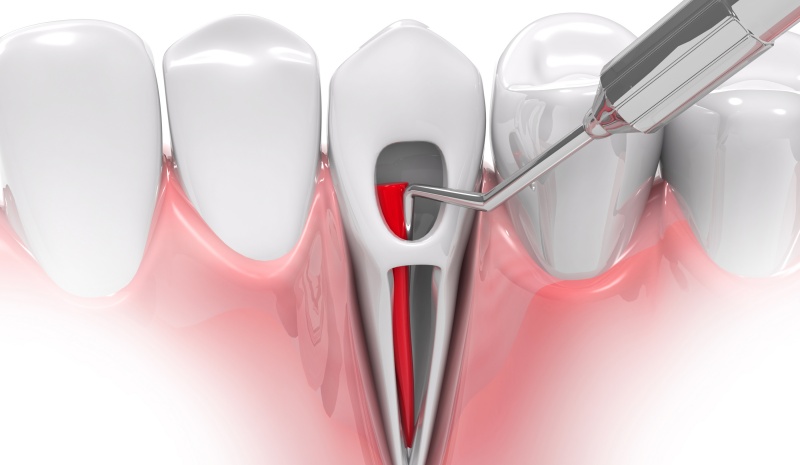


Root canal treatment fees vary depending on the complexity of the case, the number of canals within the tooth, and whether the treatment is a first-time procedure or a retreatment.
Where a specialist referral to Dr Philip Mitchell is required, this will be reflected in the fee. In all cases, your treatment plan and full fee breakdown will be discussed with you in advance; there will never be any surprises. We offer complete transparency at every stage.

Common signs include a persistent toothache, sensitivity to heat or cold that lingers, a discoloured tooth, swelling near the gum, or a visible abscess. However, some infections cause no noticeable symptoms at all and are only detected on X-ray.
If you are experiencing dental pain of any kind, we would encourage you not to wait; book an appointment so we can assess the situation and advise you appropriately.
Your natural teeth are always the best option when they can be preserved. Nothing artificial replicates the function, feel, and structural benefit of a healthy natural tooth.
Losing a tooth can affect the surrounding teeth, the bite, the jawbone, and long-term oral health. Root canal treatment, followed by a crown, can restore a tooth to full function for many years, sometimes for life.
Your consultation begins with a conversation about your symptoms, how long you have had them, and any relevant dental history. Your dentist will then carry out a clinical examination of the affected tooth, which typically includes a series of simple tests to assess the health of the nerve, such as applying a cold stimulus or gentle pressure, and taking X-rays to examine the root canals and surrounding bone.
In some cases, a CBCT scan may be recommended to provide a more detailed three-dimensional view of the root structure. By the end of the appointment, you will have a clear diagnosis, an honest explanation of what is happening inside the tooth, and a full understanding of the treatment options available to you, including what happens if the tooth is left untreated. There is no obligation to proceed with anything on the day.
This is the question we hear most often, and the honest answer is that modern root canal treatment is very rarely painful. The procedure is carried out under local anaesthetic, which numbs the tooth and surrounding area completely.
Most patients are genuinely surprised by how comfortable the experience is. Any mild soreness afterwards is typically short-lived and easily managed with over-the-counter pain relief.
A straightforward root canal on a single-canal tooth (such as a front tooth) can often be completed in a single appointment of around 60 to 90 minutes. More complex teeth with multiple canals, such as molars, or cases requiring specialist input may take longer and may require two appointments. Your dentist will give you a realistic time estimate at your assessment.
Without treatment, an infected tooth will not heal on its own. The infection can spread, cause increasing pain, and ultimately result in an abscess or the loss of the tooth altogether.
Root canal treatment is almost always preferable to extraction; it saves your natural tooth, maintains the surrounding bone structure, and avoids the need for an implant or bridge to fill the space.






Whether you’re booking your first appointment, have a question about our treatments, or simply want advice on your dental care — our friendly team is here to help.


