

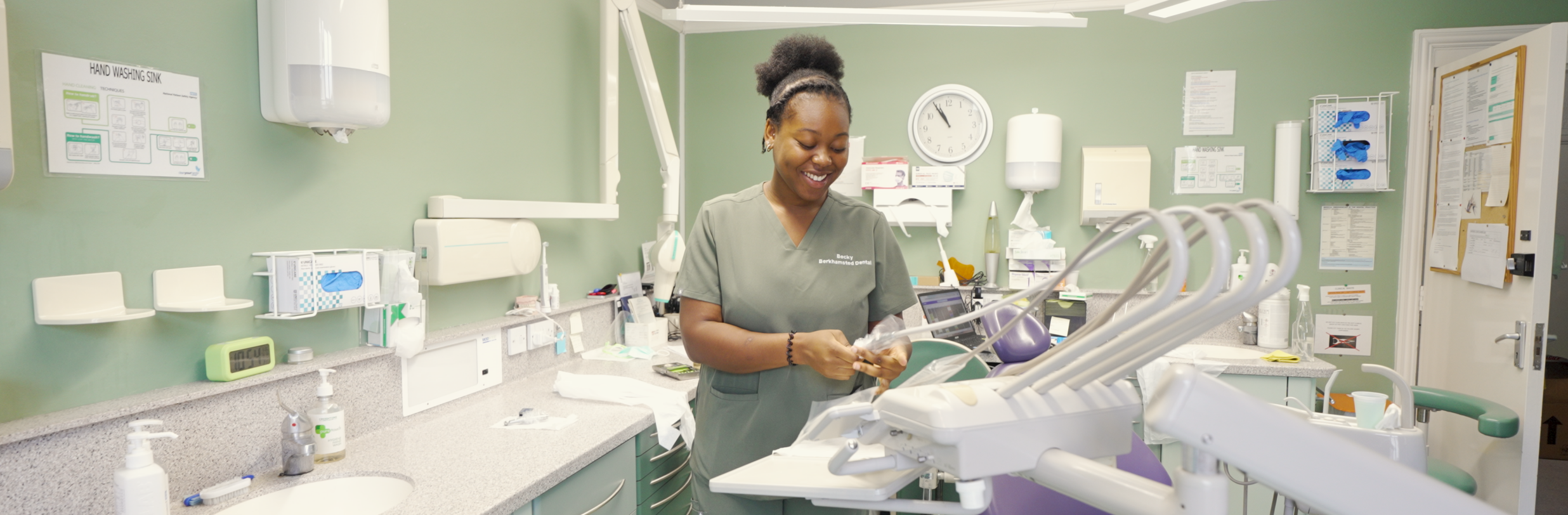
The decision to recommend oral surgery is never taken lightly at Berkhamsted Dental. Our clinicians will always explore the full range of options with you, including non-surgical alternatives where they exist and ensure you are fully informed before any treatment proceeds.

Impacted or partially erupted wisdom teeth are one of the most common reasons for oral surgery. When there is insufficient space for the tooth to emerge fully, it can cause pain, infection, damage to adjacent teeth and cyst formation. Surgical removal is often the most appropriate long-term solution.
Some teeth, those with curved or complex roots, significant decay or that have broken at or below the gum line, cannot be removed with a simple extraction. Surgical extraction involves accessing the tooth through the gum to remove it safely and with minimal disruption to the surrounding tissue.
Patients who have experienced bone loss following tooth loss may require bone grafting before a dental implant can be placed. Oral surgery also encompasses procedures such as sinus lifts, which create the space and bone density needed for implants in the upper jaw. These procedures are planned in precise detail using our in-house CBCT scanner.
Cysts can develop around impacted teeth, at the root of a tooth following infection or within the jaw tissue. Most are benign and straightforward to manage, but they require surgical removal and histological assessment to confirm their nature. Early detection through routine imaging allows intervention before significant bone loss occurs.
Teeth that have failed to emerge naturally, often canines, may need to be surgically uncovered to allow orthodontic treatment to guide them into position. This procedure is carried out in close coordination with the treating orthodontist.
When root canal treatment has not fully resolved an infection at the tip of the root, an apicoectomy may be recommended, a minor surgical procedure to access and seal the root tip directly. This can save a tooth that might otherwise require extraction.
Where surgery is recommended, the decision is never taken lightly. Our clinicians will always explore the full range of options with you, including non-surgical alternatives where they exist and ensure you feel completely comfortable and fully informed before any treatment proceeds. Surgery is a means to an end: preserving your oral health, relieving pain or enabling a subsequent treatment such as an implant. It is carried out with that goal always in mind.
Dr Fleur Mumford’s approach is calm, thorough and entirely patient-centred. Patients who arrive anxious consistently leave feeling informed, reassured and well cared for. That is not a coincidence. It is the result of a clinician who genuinely takes the time.


Oral surgery fees vary significantly depending on the nature and complexity of the procedure, a simple surgical extraction differs considerably from a multi-stage procedure involving bone grafting or pathology management. In all cases, you will receive a full treatment plan and fee breakdown before any procedure is carried out, so that you can make a fully informed decision. There are never any unexpected costs.

Your consultation begins with a thorough review of your dental and medical history, followed by a clinical examination of the area of concern. This will typically include X-rays, and in more complex cases, a CBCT scan to give your surgeon a detailed three-dimensional picture of the tooth, roots, surrounding bone, and any nearby anatomical structures.
Your surgeon will explain their findings clearly, discuss the procedure being recommended, and walk you through what to expect before, during, and after treatment, including anaesthetic options, recovery time, and any aftercare instructions. You will have the opportunity to ask as many questions as you need.
A full treatment plan and fee breakdown will be provided before any work is agreed, and there is no pressure to proceed at the consultation itself.
CBCT (Cone Beam Computed Tomography) is a three-dimensional imaging system that produces highly detailed images of the teeth, roots, jawbone and surrounding structures, far beyond what a conventional dental X-ray can show.
Not every procedure requires one, but for complex extractions, implant planning, assessment of cysts or pathology and certain other cases, it provides a level of detail that significantly improves accuracy and safety. The scan is available on-site at Berkhamsted Dental, so there is no need to attend an external imaging centre.
All oral surgery at Berkhamsted Dental is carried out under local anaesthetic, which numbs the area thoroughly so that you feel no pain during the procedure. Some discomfort and swelling in the days following surgery is normal and can be managed with over-the-counter pain relief.
Dr Fleur will talk you through exactly what to expect before and after, so there are no surprises.
Sedation options can be discussed at your consultation with Dr Fleur Mumford for patients who experience significant dental anxiety. Conscious sedation allows you to remain in a relaxed, comfortable state throughout the procedure while still being able to respond and cooperate.
Please raise this at your consultation so that appropriate arrangements can be made.
Recovery time varies depending on the procedure. A simple surgical extraction typically allows for a return to normal activity within two to three days.
More complex procedures, particularly those involving bone grafting or the removal of deeply impacted teeth, may involve a longer recovery period of one to two weeks. Dr Fleur will give you a realistic and honest picture of what to expect based on your specific case.
You will be given aftercare instructions and, where appropriate, a prescription for pain relief or antibiotics. Some swelling and tenderness for three to five days is normal.
You should avoid smoking, drinking through a straw, and vigorous rinsing for the first 24 hours, as these can dislodge the blood clot that forms to protect the socket. A review appointment will be scheduled to check that healing is progressing well.






Whether you’re booking your first appointment, have a question about our treatments, or simply want advice on your dental care — our friendly team is here to help.


